 Whatsapp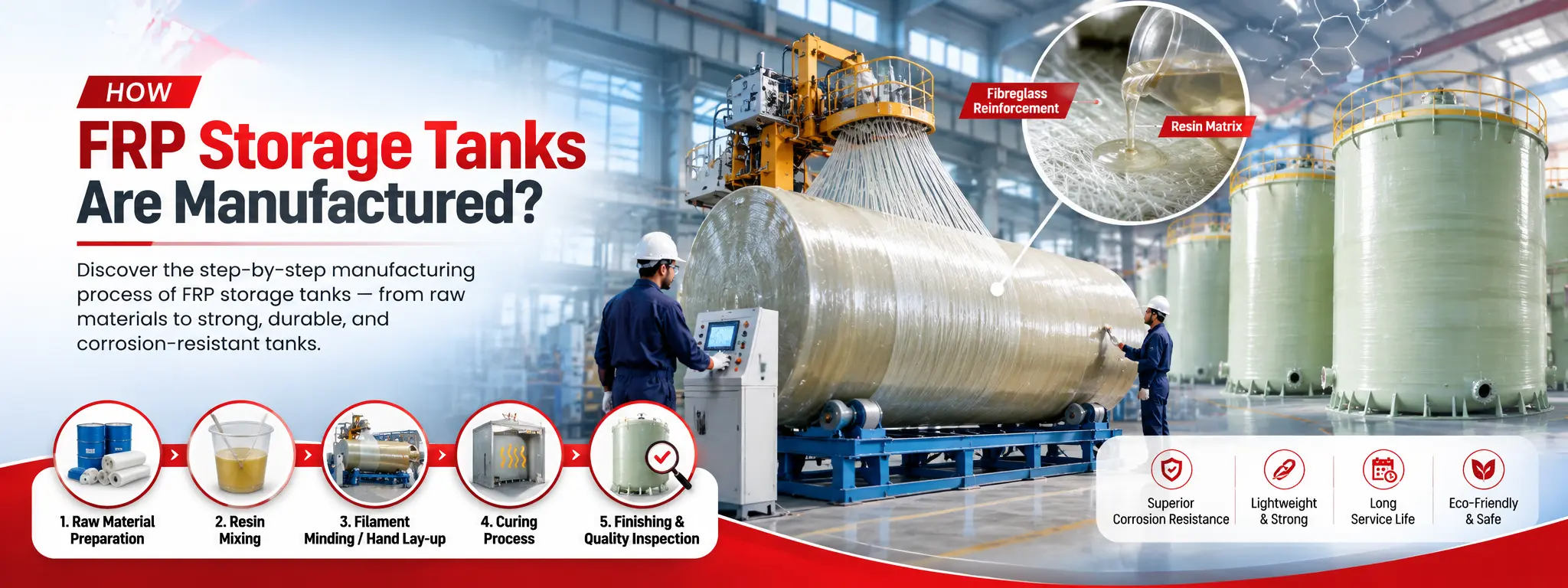
An FRP tank (Fiberglass Reinforced Plastic tank) is manufactured by winding or laminating layers of glass fiber and resin around a mold, curing the structure into a rigid, corrosion-resistant vessel. Depending on tank size and wall thickness, FRP tank manufacturing typically takes three to ten days from mold setup to final testing.
There's a fiberglass tank outside a fertilizer unit near Vadodara that's held concentrated phosphoric acid since 2009 — no relining, no replacement, just an annual inspection. Ask the plant engineer why an FRP tank holds up like that, and he won't talk about the fiberglass at all. He'll talk about the resin batch and the cure schedule the manufacturer used before the tank ever left the factory.
That's really the whole story of FRP tank manufacturing: glass fiber soaked in resin, wound or laminated onto a mold, then cured until the resin fully cross-links into a rigid shell.
Most articles on FRP tanks stop at that one-line answer. This one keeps going — through the materials, the machine settings, the checkpoints a serious FRP tank manufacturer won't skip, and the small decisions that quietly decide whether an FRP tank lasts five years or twenty-five.
An FRP storage tank is a cylindrical or vertical vessel built from fiberglass reinforcement embedded in a thermosetting resin, used to store water, acids, alkalis, solvents, and industrial effluents. It's manufactured in layers rather than as a single material, which is what sets FRP tank construction apart from steel or plastic tanks.
Picture a cross-section of an FRP tank and you'd see three distinct zones, not one uniform material:
A steel tank is basically one material managing every job at once. An FRP tank splits the work across layers, and that division is exactly why FRP tank manufacturing sequence matters so much — get one layer wrong and the rest can't compensate for it.
Four ingredient families show up in nearly every FRP water tank build:
| Material | Role | Typical Options |
|---|---|---|
| Resin | Binds the glass, forms the chemical barrier | Isophthalic polyester, vinyl ester, epoxy |
| Reinforcement | Carries the structural load | E-glass roving, chopped strand mat, woven roving |
| Additives | Fine-tune performance | UV stabilizers, flame retardants, pigments |
| Catalyst system | Starts and controls curing | MEKP, cobalt naphthenate |
Resin choice does most of the heavy lifting on chemical compatibility. A tank going into hydrochloric acid or sodium hypochlorite service almost always needs vinyl ester resin; a tank meant to hold raw water can get by on ordinary isophthalic resin at a fraction of the cost.
A rough rule fabricators lean on internally: if what's going inside has a pH under 3 or over 11, isophthalic resin isn't going to hold up long-term — vinyl ester or epoxy becomes the only real option.
A steel mandrel is cleaned and coated with a release agent so the cured tank can be pulled off in one piece. For wound tanks, this mandrel spins on a winding machine, horizontal or vertical depending on tank orientation.
A thin, resin-rich coat — roughly half a millimeter — gets sprayed onto the mold. This becomes the surface that actually contacts the liquid, and it's picked for chemical resistance, not strength.
Chopped strand mat soaked in resin goes on next, typically two to three plies. Its only job is stopping liquid from ever reaching the structural wall behind it.
Continuous glass roving winds around the rotating mandrel at a carefully chosen angle — 54.7 degrees is the figure most engineers reach for, since it balances hoop stress against axial stress reasonably well. Larger or oddly shaped tanks skip winding altogether and get built by hand instead, with technicians laying woven roving and resin in successive passes.
Nozzles, manways, and support saddles get extra laminate. These are the highest-stress spots on the whole vessel, and skipping reinforcement here is a common reason tanks fail years down the line.
Flanges and outlets are laminated directly into the wall rather than bolted on afterward, which is what keeps those junctions from becoming leak points under pressure.
The tank sits for 24 to 72 hours at controlled temperature. Some shops push it further with an oven post-cure at 60-80°C to make sure the resin fully cross-links rather than staying partially set.
Before anything ships, it goes through a hydrostatic pressure test, a Barcol hardness check to confirm the cure is complete, ultrasonic thickness readings at several points, and a visual pass for pinholes or dry spots.
Skip a step here, and it rarely shows up on delivery day — it shows up two or three years into service, usually as a leak nobody can immediately explain.
| Filament Winding | Hand Lay-Up | |
|---|---|---|
| Fiber placement | Machine-controlled, precise | Manual, more variable |
| Suited to | Standard cylindrical vessels | Oversized or irregular shapes |
| Strength consistency | Higher | Depends on the crew |
| Speed | Faster for standard sizes | Slower, more labor |
Neither method is universally "better." Winding wins on consistency for a standard vertical tank; lay-up wins when the shape or size doesn't fit on a winding machine at all.
Manufacturing FRP chemical storage tanks follows the same core sequence as a standard FRP tank, but three things get tightened up considerably. Vinyl ester or epoxy resin replaces the standard isophthalic system. The corrosion barrier gets thicker — often 3mm or beyond — sometimes with a synthetic veil layered between the gel coat and the chopped strand mat for extra protection. And fittings frequently move to PTFE-lined or PVDF construction for anything highly corrosive or running hot.
A vessel built to hold 98% sulfuric acid, for instance, typically carries a dual-veil corrosion barrier and epoxy vinyl ester resin from end to end — a completely different spec sheet from a tank storing raw water, even though the two might look nearly identical sitting side by side. That's the trap buyers fall into: assuming fiberglass is fiberglass, when the resin system underneath is actually what decides whether the tank survives five years or twenty-five.
An FRP water storage tank carries a lighter chemical burden than a chemical storage vessel but faces its own set of demands — food-grade resin compliance for drinking water, strong UV resistance since these tanks usually sit outdoors for years, and sometimes a sandwich-core wall with a foam layer between two laminate skins to cut down on algae growth and heat gain.
Because the chemical exposure is mild, general-purpose isophthalic or orthophthalic resin does the job fine, which keeps costs down without giving up anything in terms of performance.
Quality varies more than most buyers expect across FRP tank manufacturers. Before placing an order, it's worth asking a few pointed questions:
RD India is one of the FRP tank manufacturers in India that builds its process around exactly these checkpoints — documented resin specs, in-house hydrostatic testing, design validation against composite tank standards. Whoever you end up shortlisting, push for the same paperwork before committing.
| Defect | Usual Cause | How It's Avoided |
|---|---|---|
| Blistering | Trapped air, incomplete resin wet-out | Vacuum degassing, controlled winding tension |
| Delamination | Weak bond between layers, contamination | No time gaps between plies, clean surfaces |
| Pinholes | Air trapped during gel coat spraying | Controlled spray thickness, clean cure environment |
| Nozzle Leaks | Not enough reinforcement at penetrations | Extra laminate, proper load calculations |
| Early UV Breakdown | Thin or missing top coat | UV-stabilized resin in the final layer |
Most tank failures inspectors get called out for not tracing back to bad raw material at all — they trace back to a shortcut somewhere in the layering sequence or the cure schedule.
| FRP Tank | Steel Tank | HDPE Tank | |
|---|---|---|---|
| Corrosion Resistance | Excellent | Needs coating or lining | Good |
| Weight | Light | Heavy | Light |
| Practical Size Limit | Very large, custom-built | Very large | Capped by rotomolding size |
| Typical Lifespan | 20-25 years | 10-15 years (uncoated) | 10-15 years |
| Upfront Cost | Moderate | Lower for carbon steel | Lower |
| Chemical Range | Wide, resin-dependent | Limited without lining | Moderate |
FRP costs more going in than HDPE, but in genuinely corrosive service it tends to outlast both alternatives — which usually makes the cost-per-year of service the lower figure over time.
An FRP tank built correctly should give 20-plus years of service, but that number assumes some care after installation too:
Manufacturers like RD India generally hand over an inspection schedule at delivery, and it's worth asking for one regardless of who builds the tank — it's the cheapest way to stretch the tank's working life well past its warranty period.
Manufacturing an FRP tank has less to do with "spraying fiberglass" and more to do with engineering a layered composite — resin choice, winding precision, reinforcement where stress concentrates, and a cure schedule nobody rushes. All of that compounds into how long the vessel actually survives once it's in the field.
Whether you're sourcing an FRP chemical storage tank for a processing line or an FRP water storage tank for a housing society's water supply, the manufacturing process — not the paint job — is what should drive the decision. Ask for the resin spec, the corrosion barrier thickness, and the hydrostatic test report before you compare rupee figures. A tank that's ten thousand cheaper but skipped post-curing will cost far more once it's leaking two years in. If you'd rather skip the guesswork, get in touch with our tank specialists and we'll help you match the right resin and design to your application before you request a quote.
Q1: What is an FRP storage tank made of?
Glass fiber reinforcement set in a thermosetting resin — usually isophthalic polyester, vinyl ester, or epoxy — built up in layers: a gel coat, a corrosion barrier, and a structural laminate on top of that.
Q2: How long does frp tank manufacturing take?
Anywhere from three to ten days, depending on the tank's size, wall thickness, and how long the cure schedule runs.
Q3: What's the real difference between filament winding and hand lay-up?
Winding is machine-controlled and more consistent; lay-up is done by hand and suits tanks too large or oddly shaped for a winding machine.
Q4: How long do frp tanks actually last?
Twenty to twenty-five years is typical when the resin matches the stored liquid and someone's actually inspecting it once a year.
Q5: Is it safe to store drinking water in frp tank?
Yes, provided the resin system is food-grade or NSF/ISI-compliant — this is standard practice for potable water applications.
Q6: How do I pick a frp manufacturer I can trust?
Look for one that puts resin specs in writing, tests every unit hydrostatically rather than just a sample batch, follows a standard like ASME RTP-1 or BS 4994, and spells out warranty coverage explicitly.
Q7: Can frp tanks handle strong acids and alkalis?
Yes — with vinyl ester or epoxy resin and a thicker corrosion barrier, they're routinely used for sulfuric acid, hydrochloric acid, and caustic soda storage.
Q8: What usually goes wrong when a frp tank fails early?
Almost always a mismatched resin, a corrosion barrier that's too thin, an incomplete cure, or weak reinforcement around the fittings — rarely the fiberglass itself.