
Introduction
If you're planning to install portable or semi-permanent toilet units at a construction site, factory, or public facility, you've likely come across FRP toilet cabins. Project managers and procurement teams often ask the same questions before buying: what is an FRP toilet cabin, how does it hold up under daily site conditions, and how does it differ from other cabin materials?
This article covers how these cabins are built, where they're used, what to check before ordering, and the mistakes that lead to a poor fit between product and site. Understanding the basics first makes it easier to work with any FRP toilet cabin manufacturer in Delhi NCR and avoid costly reordering later.
What Is an FRP Toilet Cabin?
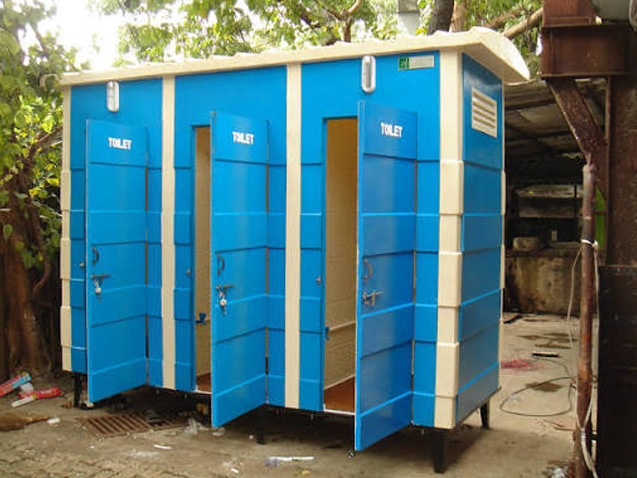
An FRP toilet cabin is a prefabricated sanitation unit built using Fiberglass Reinforced Plastic (FRP) panels instead of mild steel, plain plastic, or brick and mortar. FRP is a composite made by combining glass fibers with a resin matrix, giving the panel a strength-to-weight combination that's hard to get from a single material alone.
In a typical unit, the outer shell, door, and often the internal partitions are molded from these panels and assembled onto a supporting frame. Some cabins are single-unit structures, while others are multi-cabin blocks with separate compartments, depending on expected users and available space.
Compared to brick-and-mortar structures, an FRP cabin doesn't need curing time or masonry labor. Compared to plain plastic or thin sheet-metal cabins, FRP panels are generally more resistant to cracking, though actual performance still depends on panel thickness and build quality.
Types of FRP Toilet Cabin provided by RD India
Readymade Toilet Cabin- ₹ 18,500/price
| Product Details | Information |
|---|---|
| Material | FRP |
| Size | 3'(L) X 3.5'(W) X 7'(H) |
| Usage/Application | Events and Melas |
| Brand | R D INDIA |
| Built Type | Panel Build |
| Color | Any |
| Shape | Rectangular |
| No. Of Compartments | Single Seater |
| Country of Origin | Made in India |
Frp Labour Toilet Cabin - ₹ 18,500/price
| Product Details | Information |
|---|---|
| Size | 3'(L) X 3.5'(W) X 7'(H) |
| Material | FRP |
| Built Type | Panel Build |
| Brand | R D INDIA |
| Usage/Application | Construction Site |
| No. Of Compartments | Single Seater |
| Color | Any |
Blue and White FRP portable toilet cabin with metal frame - ₹ 18,500/price
| Product Details | Information |
|---|---|
| Size | 3.5 x 3.5 x 7 Feet |
| Material | FRP |
| Built Type | Modular |
| Shape | Rectangular |
| Brand | RD INDIA |
| Color | Green |
| Usage/Application | Construction |
How Is an FRP Toilet Cabin Used and Installed?
Placement and Setup
FRP toilet cabins are positioned wherever temporary or semi-permanent sanitation is needed, without the groundwork a permanent structure would require. Most units sit on a level, prepared surface and connect to a water supply and a waste disposal or septic arrangement, depending on what the site already has. Some sites use a soak pit, others connect to existing drainage, and the right approach depends on local regulations and layout.
Mobility and Relocation
A practical advantage many buyers value is that these cabins can usually be relocated as a project progresses. Sanitation needs often shift as work moves from one zone to another, and a cabin that can be lifted and repositioned saves the cost of a new structure each time. Relocation still requires proper handling equipment, and how often the unit will move should be discussed with the supplier before ordering, since it affects the recommended build specification.
Key Benefits of FRP Toilet Cabins
FRP toilet cabins are chosen over other options for a combination of practical reasons, though not every benefit applies equally to every project:
- Corrosion and weather resistance: FRP doesn't rust the way metal cabins can, which matters where the unit faces rain and moisture over extended periods.
- Lightweight construction: FRP is considerably lighter than brick or steel-clad alternatives, simplifying transport and installation, and requiring less handling equipment to move.
- Low maintenance: Because the material doesn't flake or rust, day-to-day upkeep tends to be simpler, though routine cleaning and plumbing checks are still necessary.
- Chemical resistance: FRP generally holds up well against common cleaning agents and mild chemical exposure.
These benefits make FRP practical for many settings, but it isn't automatically the right choice for every scenario. Sites with extreme structural demands or specific local building code requirements may need a different evaluation.
Where Are FRP Toilet Cabins Commonly Used?
FRP toilet cabins are used across settings where a durable but non-permanent sanitation solution is needed:
- Construction sites, where sanitation is required for the project duration and often needs to move as work progresses
- Manufacturing plants and warehouses, particularly outdoor or semi-covered areas without existing washroom infrastructure
- Infrastructure and road projects, where facilities need to be set up quickly at remote locations
- Public events and exhibitions, where sanitation needs exist only for a limited period
Not every application needs the same configuration, which is why discussing actual usage patterns with a supplier tends to produce a better outcome than choosing a standard unit off a catalogue.
What to Consider Before Choosing an FRP Toilet Cabin?
A few practical factors tend to determine whether a cabin performs well on site:
- Number of users and traffic pattern. A cabin for a handful of staff has different requirements than one serving a larger workforce.
- Water and drainage availability. Confirm the water source and waste disposal arrangement the site can support, since this affects the plumbing configuration.
- Site conditions and exposure. Units in direct sun, heavy rainfall, or dusty environments may need different panel specifications.
- Mobility and customization. If the cabin will be relocated frequently, or needs specific dimensions or fittings, flag this before fabrication starts.
- Quantity and timeline. Bulk requirements for larger projects usually need lead time to plan procurement properly.
Because specifications vary between manufacturers and projects, it's worth asking for details specific to your requirement rather than assuming a standard figure applies.
Common Problems or Mistakes When Using FRP Toilet Cabins
A few recurring issues tend to come up on sites, most of which are avoidable with upfront planning:
- Undersized units: Ordering a cabin sized for a smaller crew than the site actually has leads to overuse and faster wear.
- Poor foundation or leveling: Placing a cabin on uneven ground can cause doors to misalign and drainage to work poorly.
- Inadequate plumbing connections: An undersized water line or poorly planned waste system creates ongoing maintenance issues regardless of the cabin's quality.
- Skipping maintenance: Even low-maintenance materials need periodic cleaning and plumbing checks; neglecting this shortens the unit's useful life.
Most of these problems trace back to insufficient discussion with the supplier before ordering, which is why clear communication about site conditions matters more than the material choice alone.
Why FRP Is Considered for Toilet Cabin Applications?
FRP is used for toilet cabins mainly because light weight, moisture resistance, and low maintenance suit how these units are actually deployed — set up quickly, exposed to outdoor conditions, and sometimes relocated over a project's lifetime. It isn't presented here as universally superior to every alternative material; the right choice still depends on budget, expected usage, and site-specific conditions. For frequent movement, variable weather exposure, or a need to avoid rust over time, FRP is one of the materials commonly evaluated alongside other options.
How RD India Can Help With FRP Toilet Cabins?
RD India manufactures and supplies FRP products, including toilet cabins, for industrial, commercial, and construction use across Delhi NCR. As an FRP toilet cabin manufacturer, RD India works with businesses to understand site requirements, usage patterns, and customization needs before finalizing a configuration. For teams comparing options or sourcing from an FRP toilet cabin dealer in Delhi, discussing project details with the manufacturer directly helps match the unit to actual site conditions rather than defaulting to a generic size.
Conclusion
FRP toilet cabins offer a practical combination of durability, low maintenance, and ease of relocation that suits many construction, industrial, and temporary-use settings. The right specification depends on factors like user count, site exposure, drainage arrangements, and how often the unit needs to move. Buyers who discuss these details with a manufacturer or dealer, rather than ordering a standard unit without context, tend to get better long-term performance from their investment. Working with an experienced and responsive FRP toilet cabin manufacturer or dealer makes it easier to get a unit that fits the project rather than one that needs frequent workarounds after installation.
FAQs
1. How long does it typically take to install an FRP toilet cabin on site?
Installation time depends on site preparation, water and drainage connections, and the number of units being set up. Since these cabins are prefabricated, on-site work is generally faster than constructing a permanent structure, but exact timelines should be confirmed with your supplier based on your specific site.
2. Can FRP toilet cabins be customized for specific site requirements?
Yes, many manufacturers offer customization in terms of size, number of compartments, and fittings based on project needs. It's best to share your requirements upfront so the cabin is built to match your intended use.
3. Do FRP toilet cabins need a permanent foundation?
Generally no, though the surface should be level and stable to avoid issues with door alignment and drainage. Specific foundation requirements can vary depending on the unit's size and the site's ground conditions.
4. How do FRP toilet cabins compare to steel or plastic cabins in terms of maintenance?
FRP panels tend to resist rust and surface degradation better than untreated metal, and generally hold up better structurally than very thin plastic cabins. However, all cabins still require regular cleaning and plumbing checks regardless of material.
5. What should I check before choosing a supplier for FRP toilet cabins?
It helps to look at the manufacturer's experience with similar projects, their ability to customize units, their understanding of your site conditions, and their responsiveness during the planning stage rather than relying on price alone.