 Whatsapp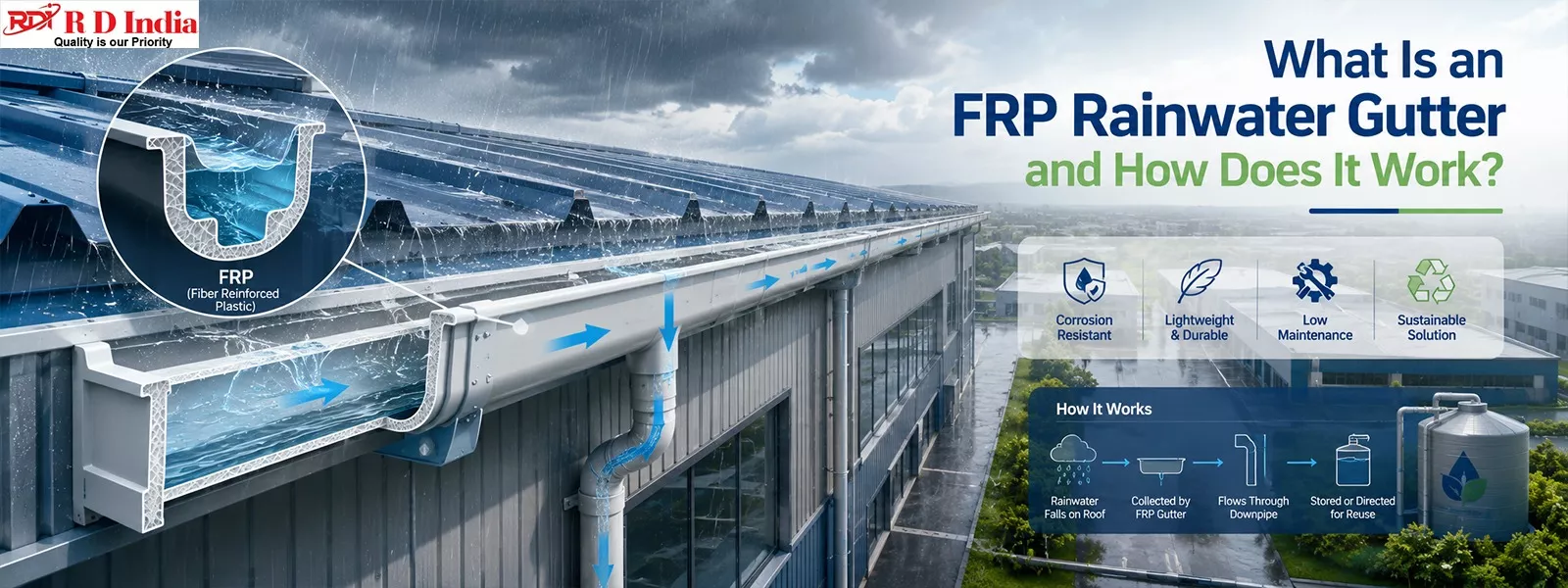
Managing rainwater effectively is a practical challenge for factories, warehouses, commercial complexes, and large infrastructure projects. When water is not channelled correctly, it damages structures, weakens foundations, and creates safety hazards on the ground. Traditional materials like mild steel or PVC have limitations — steel rusts, and PVC can crack under heavy loads or extreme temperatures. This is where FRP rainwater gutters offer a dependable alternative. Fibre Reinforced Plastic (FRP) combines strength with corrosion resistance, making it suitable for environments where conventional gutters struggle to last. This article explains what an FRP rainwater gutter is, how it functions, and why it is becoming a preferred choice across industrial and commercial projects in India.
An FRP rainwater gutter is a channel-shaped drainage component made from fibreglass-reinforced plastic. It is designed to collect and direct rainwater from rooftops, slopes, or open surfaces towards a designated drainage point or collection system. The material itself is a composite — it combines a polymer resin matrix with glass fibre reinforcement, resulting in a product that is lightweight, structurally strong, and resistant to chemical and environmental degradation.
FRP products are manufactured using processes such as hand layup, filament winding, or pultrusion. For gutters, pultrusion is commonly used because it produces uniform cross-sections with consistent mechanical properties. The glass fibres provide tensile strength, while the resin provides form and chemical resistance. Depending on the application, different resins — polyester, vinyl ester, or epoxy — are used to meet specific performance requirements.
An FRP gutter is installed along the eaves of a roof or along the perimeter of a structure. When rain falls on the roof surface, the water flows along the slope and enters the gutter channel. The gutter then directs this water through a controlled gradient towards downpipes or collection tanks. In an FRP drainage system, multiple gutter channels are connected to form a complete network, ensuring water is managed efficiently across large roof spans. The joints and connectors used in FRP systems are typically sealed with compatible adhesives or flanged fittings to prevent leakage.
The growing adoption of FRP in drainage applications is backed by tangible performance advantages. Here is a look at the main
These FRP gutter benefits make the material well-suited for demanding industrial environments where conventional materials often fall short.
FRP rainwater gutters are not a one-size-fits-all product — they are engineered for environments where performance and durability are non-negotiable. Some of the key FRP gutter applications include:
In chemical, pharmaceutical, and textile manufacturing units, the atmosphere often contains corrosive agents that deteriorate standard steel gutters within a few years. FRP gutters resist these conditions and maintain structural integrity without frequent replacement. For instance, a textile dyeing plant in Faridabad using FRP gutters across its production shed roof reported significantly reduced maintenance costs compared to its earlier galvanised iron system.
Large warehouses with wide-span roofs require a reliable drainage solution to prevent water pooling and seepage. FRP gutters, being lightweight, can be installed along extended roof lengths without adding excessive load to the structure. Many warehousing projects in Delhi NCR have adopted FRP drainage systems precisely for this reason.
Railway stations, bus depots, metro yards, and airport facilities often require durable drainage systems that can handle high rainfall volumes and resist environmental wear. FRP offers the longevity and load capacity that such infrastructure projects demand, with minimal disruption once installed.
FRP gutters are also a practical component in an FRP rainwater collection system. They serve as the first stage in collecting rooftop runoff, which is then channelled into storage tanks or filtration units. For commercial buildings and institutions in water-stressed regions, this integration helps reduce dependence on external water supply.
Selecting the right FRP gutter for a project involves more than just picking a size. Here are some important considerations:
Leaves, dust, and airborne particles can collect in gutters over time, blocking water flow. Installing mesh guards over gutter openings and scheduling periodic cleaning — especially before the monsoon season — addresses this effectively.
Undersized gutters overflow during heavy rain, while oversized ones add unnecessary cost. A proper hydraulic calculation before procurement ensures the selected profile can handle peak runoff without issue.
Like most materials, FRP expands slightly with temperature changes. Using expansion joints at specified intervals during installation prevents stress buildup and cracking over time.
Poorly sealed joints are a common source of leakage. Using manufacturer-recommended sealants and following correct installation procedures reduces this risk significantly.
The shift towards FRP in drainage systems reflects a broader change in how project engineers and facility managers evaluate material costs. While the upfront cost of FRP may be higher than PVC or mild steel, the total cost of ownership over 15 to 20 years is often lower when maintenance, replacement, and downtime costs are factored in.
For projects located in corrosive or humid environments — such as coastal industrial zones, food processing clusters, or chemical manufacturing hubs — FRP provides a level of durability that steel simply cannot match without ongoing protective treatment. In Delhi, where summer temperatures regularly exceed 40°C and the monsoon brings intense rainfall, materials that can handle thermal stress and high water volume without degrading are especially valuable.
FRP is also gaining acceptance in green building and sustainability frameworks because it reduces the need for protective coatings that contain volatile organic compounds (VOCs), and its longer lifespan means fewer replacements and less material waste.
RD India is a Delhi-based manufacturer and supplier of a wide range of FRP products designed for industrial, commercial, and infrastructure applications. With in-house manufacturing capabilities, the company produces FRP gutters in standard and custom profiles to meet the specific drainage requirements of different project types.
As an established FRP rainwater gutter manufacturer in Delhi, RD India works with project engineers, procurement teams, and facility managers to recommend the right gutter profile, resin grade, and installation approach for each application. Whether the requirement is a simple shed drainage system or a large-scale industrial rainwater collection setup, the company offers products that are built to perform in real-world conditions.
RD India's products are manufactured with quality controls in place and are available in standard lengths, with options for custom fabrication. The team also provides technical guidance on installation best practices, which helps customers avoid common issues like improper gradient, joint failures, or incorrect sizing.
An FRP rainwater gutter is a practical, durable drainage solution for industrial, commercial, and infrastructure projects where conventional materials like steel or PVC fall short. Its resistance to corrosion, low maintenance requirements, and adaptability to different environments make it a sound long-term investment. Whether used as a standalone drainage channel or as part of a larger FRP rainwater collection system, it consistently delivers reliable performance across a wide range of conditions.
For businesses evaluating drainage options for new or existing facilities, FRP is worth serious consideration — particularly in environments involving chemical exposure, high humidity, or extreme temperatures. Engaging a manufacturer with the right technical expertise ensures the system is designed and installed correctly from the start, reducing the likelihood of performance issues down the line. With the right product and proper installation, an FRP drainage system can serve a facility effectively for many years with minimal intervention.
FRP gutters are designed for long-term performance. When correctly installed and subject to routine cleaning, they can function effectively for 20 to 25 years, depending on the exposure conditions. In chemically aggressive environments, lifespan may vary based on the resin type used.
Yes. FRP gutters can be manufactured using vinyl ester or epoxy resins, which offer higher chemical resistance than standard polyester resins. This makes them suitable for chemical plants, fertiliser facilities, and other environments with reactive atmospheres. It is important to specify the chemical conditions to the manufacturer so the appropriate material grade is selected.
PVC gutters are lighter and less expensive, but they are generally suitable only for residential or light commercial use. For industrial applications involving heavy rainfall, thermal stress, or chemical exposure, FRP gutters are significantly more durable and maintain their structural properties under conditions that would cause PVC to degrade or deform.
FRP gutters are not inherently difficult to install, but they do require correct gradient setting, proper support spacing, and sealed joints to perform well. Most manufacturers provide technical guidance on installation. For larger or more complex systems, involving an experienced installation team is advisable to avoid issues such as improper slope or joint leakage.
Yes, FRP gutters are commonly used as part of a broader FRP rainwater collection system. They collect rooftop runoff and channel it towards downpipes, which then direct the water to storage tanks or filtration units. Because FRP is non-reactive, it does not leach chemicals into the collected water, making it suitable for applications where water quality is a consideration.