 Whatsapp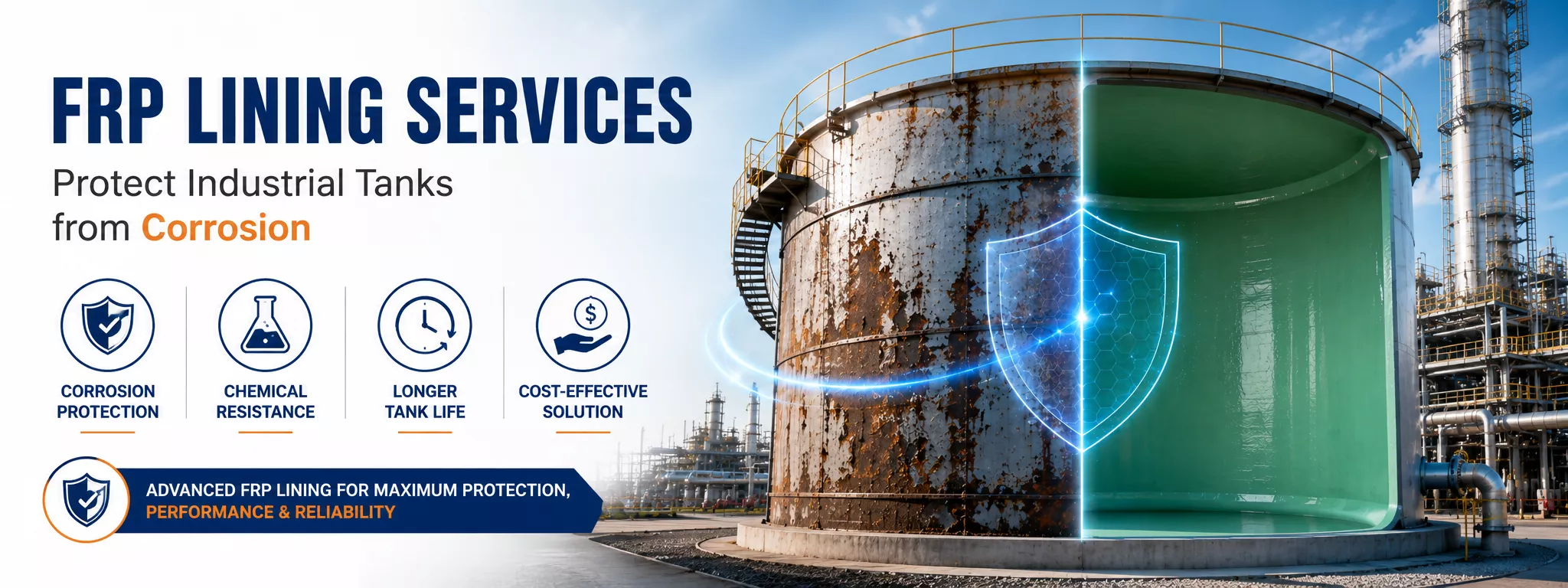
A tank doesn't fail overnight. It fails one micro-pit at a time, usually in a weld seam nobody inspected closely enough, until a plant manager is staring at a wet floor and a shutdown notice. If you've ever had to explain an unplanned outage to operations leadership, you already know why corrosion control isn't a maintenance line item - it's a production risk. At RD India, this is the exact problem our lining crews get called in to solve, usually after a tank has already started showing early signs of trouble.
A fiberglass-reinforced plastic barrier applied to the interior (and sometimes exterior) surface of a storage or process tank is what FRP lining services actually deliver. The resin - typically vinyl ester, epoxy, or polyester depending on the chemical exposure - bonds to the substrate and cures into a hard, non-porous layer that sits between the steel or concrete wall and whatever is stored inside.
The point isn't decoration. It's separation. Steel corrodes because chemicals, moisture, and oxygen reach bare metal and start an electrochemical reaction. FRP lining removes that contact entirely. No contact, no reaction, no pitting.
Tanks that hold acids, caustics, solvents, or brine solutions are the usual candidates, but the same logic applies to water treatment basins, scrubbers, and secondary containment structures. Anywhere metal meets an aggressive liquid long-term, lining becomes the cheaper alternative to replacement.
Good lining work follows a sequence, and skipping steps is where most premature failures come from.
Each stage has to pass inspection before the next starts. Rushing cure times under schedule pressure is one of the more common ways a lining job underperforms its design life.
Not every tank needs the same resin chemistry. The right system depends on what's inside the tank, the operating temperature, and how aggressive the chemical exposure is. Fiberglass's resistance to weathering and chemical attack is also why it shows up in other outdoor applications - our piece on fibreglass planter benefits is a good example of that same material logic applied differently.
| Lining Type | Best Suited For | Typical Temperature Range | Notes |
|---|---|---|---|
| Vinyl ester lining | Strong acids, oxidizers | Up to ~200°F | Good balance of chemical and thermal resistance |
| Epoxy novolac lining | Solvents, high-temp acids | Up to ~250°F | Higher cost, longer service life in harsh service |
| Isophthalic polyester | Mild acids, general chemical storage | Up to ~150°F | Economical for less aggressive media |
| Acid resistant lining (specialty vinyl ester/novolac blends) | Sulfuric, hydrochloric, hydrofluoric acid tanks | Varies by acid concentration | Formulated specifically for high-concentration acid exposure |
A chemical resistant lining chosen for the wrong media is worse than no lining at all, because it gives a false sense of protection while the resin quietly degrades underneath. Our chemical resistant lining solutions page breaks down resin selection in more depth if you're comparing systems for a specific tank.
FRP tank lining services show up across a fairly predictable set of industries:
Any facility running a corrosive process and trying to stretch the life of existing steel infrastructure is a candidate rather than budgeting for full tank replacement. See our industrial tank solutions overview for a broader look at which processes typically need lining versus replacement.
A few patterns show up again and again in failed or underperforming lining jobs. Most of these come down to treating lining as an afterthought rather than understanding the tank itself first - if you're newer to this and want the basics before the mistakes, our overview on what FRP tanks are and how they're used is a good starting point.
A cheaper polyester system might handle water fine but degrade in weeks against concentrated acid.
Moisture, salt contamination, or residual oil on the steel surface undermines adhesion no matter how good the resin is.
Tanks that heat and cool repeatedly need a lining system rated for that flex, or the laminate will eventually crack at stress points.
A lining that looks dry isn't necessarily fully cured chemically. Putting a tank back into service too early is a leading cause of early blistering.
Different tanks, different chemicals, different lining thickness and resin - a blanket spec across a whole facility often means some tanks are over-engineered and others are under-protected.
A tank that shows minor rust bleed or surface pitting during a routine walk-around is often written off as cosmetic. In reality, that's usually the first visible sign that the substrate is no longer behaving like a corrosion resistant tank, and waiting for the next scheduled shutdown to address it can turn a simple recoat into a full relining job.
Lining work in most industrial settings is guided by recognized bodies such as NACE (now AMPP ) and ASTM standards covering surface preparation, coating thickness measurement, and holiday detection. Manufacturers of resin systems also publish chemical resistance charts specific to concentration and temperature, and these should be checked against actual service conditions rather than assumed from a general product data sheet. None of this replaces engineering judgment on-site - standards set a baseline, not a guarantee, and site-specific factors like ambient humidity during application still influence the outcome.
Lining a tank correctly depends less on the resin brand and more on the people applying it. Surface prep judgment, recognizing when ambient conditions aren't right for lamination, and knowing when a resin system is genuinely wrong for a chemical - these come from having lined enough tanks to have seen the failure modes firsthand.
RD India's crews have worked across chemical, water treatment, and power plant tanks, which is what lets them catch problems a first-timer would miss - a substrate that looks dry but is still holding moisture below the surface, or a tank geometry that traps stress at a specific weld joint. That field experience feeds directly into how our lining services are scoped and specified for each site, rather than applied as a one-size-fits-all package.
Tank corrosion is predictable, which is exactly why it's preventable. A properly specified and applied FRP lining buys years of service life from infrastructure that would otherwise need early replacement, provided the resin matches the chemical exposure and the application follows a disciplined process rather than a rushed schedule. If a tank is showing early corrosion signs or coming up for a scheduled inspection, it's worth getting a lining assessment before the decision gets made for you by a leak.
RD India works through this kind of assessment regularly, and if you want a second opinion on a tank's condition or a resin recommendation for a specific chemical, our tank lining and coating team can walk through the options with you.
How long does an FRP tank lining typically last?
Service life depends heavily on chemical exposure and temperature, but a correctly applied lining on a well-prepared substrate commonly lasts well over a decade before recoating is needed.
Can FRP lining be applied over an existing coating?
Generally no. Most specifications call for removing prior coatings down to bare substrate, since layering new resin over old coating risks poor adhesion and hidden delamination.
Is FRP lining suitable for tanks with elevated operating temperatures?
Yes, but the resin system has to be selected for that range. Standard polyester systems aren't rated for the same temperatures as epoxy novolac or high-temp vinyl ester formulations.
What's the difference between tank lining and tank coating?
Tank lining and coating are related but not identical - coatings are typically thinner protective films, while a lining system usually involves a reinforced laminate build-up designed for continuous immersion service rather than just surface protection.
How do you know if an existing tank lining is failing?
Common warning signs include blistering, discoloration, a chemical odor near the tank exterior, or thickness readings during inspection that fall below the original spec. Any of these warrants a closer inspection before the next fill cycle.